How Buhari Made Osinbajo President For 150 Days And Tinubu Has Never Made Shettima President For 1 Day
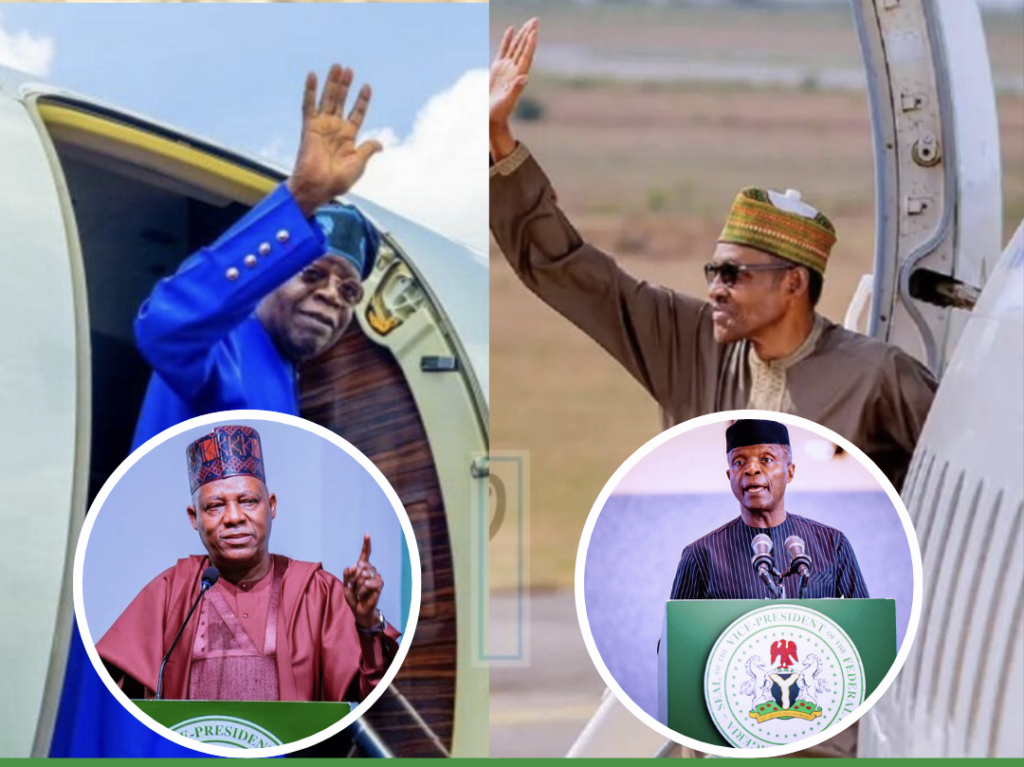
President Bola Ahmed Tinubu departed Abuja today, Sunday August 30, 2026, for Europe to begin a three-week vacation as part of his annual leave, with London as his first stop. According to his Special Adviser on Information and Strategy Bayo Onanuga, the trip is a working vacation and he is expected to return after joining the hectic campaign for the January 2027 election.
But just like all his previous vacations, today’s Presidency statement is silent on Section 145 of the Constitution and silent on whether power was transmitted to Vice President Kashim Shettima. Since assuming office on May 29, 2023, President Tinubu has not at any point formally handed over power to his Vice President to act as President, even during long foreign trips.
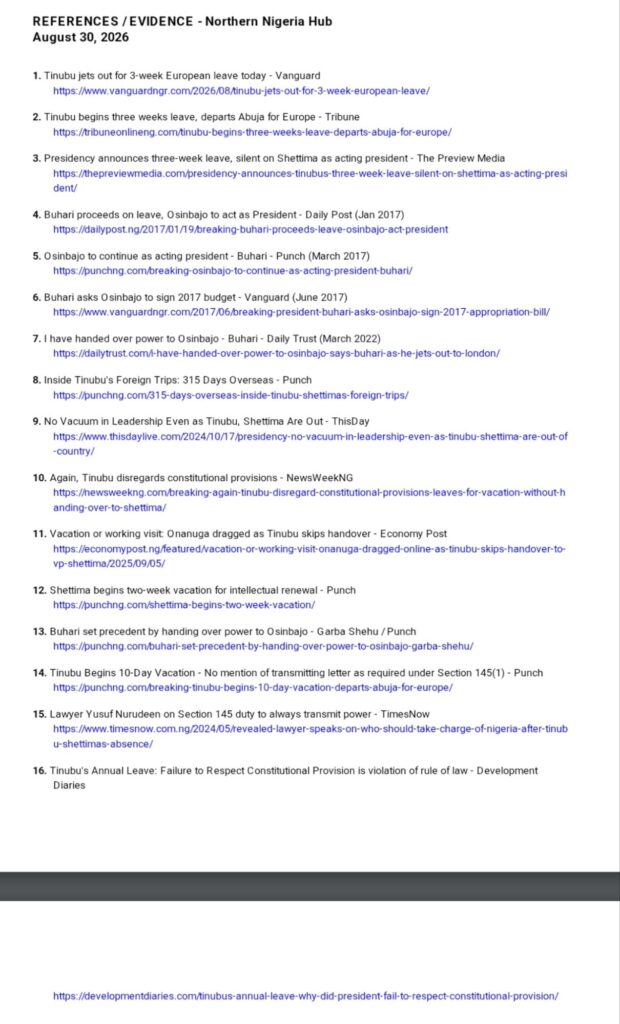
His predecessor Late Muhammadu Buhari did the exact opposite and built a precedent around it. On January 19, 2017, Buhari formally wrote to the National Assembly, informing them he was proceeding on a 10-day vacation to London and that Vice President Yemi Osinbajo would perform the functions of his office. That leave was later extended to 49 days on medical grounds, with Osinbajo fully in charge.
When Buhari returned on March 10, 2017 after nearly two months, he shocked the nation by declaring that Osinbajo should continue as Acting President while he rested further. He told the nation he came back towards the weekend so that the Vice President will continue and he will continue to rest, a public vote of confidence rarely seen in Nigeria’s history.
Buhari’s biggest test of trust came on May 7, 2017 when he left for London for 103 days. Not only did he again transmit power to Osinbajo, he authorized his deputy to sign the 2017 Appropriation Bill into law – the first time in Nigeria’s history an Acting President signed the national budget. Even as late as March 2022, before jetting out for a medical check-up, Buhari told State House correspondents at the airport that constitutionally when he is away, the Vice President is in charge.
Every long leave brings the same constitutional controversy. When Tinubu took a 10-day working vacation in September 2025 between France and the UK, the Presidency statement made no mention of transmitting a formal letter to the National Assembly as required under Section 145(1) to enable Vice President Kashim Shettima to act in his absence. This pattern was also seen in October 2024 when he spent over two weeks in the UK and France on a similar working vacation without a formal handover.
Legal experts have been clear on this. Lagos-based lawyer Yusuf Nurudeen explained that the president is under a constitutional duty to always transmit power whenever he embarks on medical vacation or any form of vacation whatsoever under Section 145. Another analysis described Tinubu’s decision to embark on annual leave without transmitting power to Shettima as a violation of the rule of law, stating that the constitution expressly mandates that whenever the president proceeds on vacation, he must formally notify the National Assembly and hand over executive powers.
In October 2024 when both President and Vice President were out of the country at the same time – Tinubu in the UK and Shettima in Sweden – the Presidency defended itself by saying there is no vacuum in leadership and both leaders continued to discharge duties from abroad. Nigerians on social media repeatedly asked whether he was not supposed to transmit a handover letter to the National Assembly as required by law.
Beyond the legal debate, the contrast raises questions about precedent and governance. Vice President Kashim Shettima returned on August 18, 2026 from his first two-week leave since taking oath in 2023, a break approved by President Tinubu for intellectual renewal and study. Twelve days later, his principal departed for a three-week vacation in Europe. While former President Buhari gave his vice president over 150 cumulative days as Acting President and set what his own spokesman described as a national precedent for power transfer, President Tinubu has yet to give his vice president a single day as Acting President in over three years. As political activities intensify ahead of the January 2027 general elections, the question is whether the constitutional practice of transmitting power during long absences will be upheld or quietly set aside.