“You Cannot Create Crime By Interpretation” — Lawyer Cites Appeal Court Judgment To Warn Police In Maiduguri Against Charging Citizens For Wearing ‘Tinubu Must Go’ T-Shirts, Writing ‘H.E’

A Borno-based Lawyer and Rights Activist, Hamza N Dantani Esq, has warned the Police in Maiduguri and prosecuting authorities to exercise greatest caution before charging citizens with the offence of Inciting Public Disturbance, saying criminal offences cannot be created through loose, literal or politically convenient interpretations.
Dantani, in a legal opinion released on Tuesday, said he has seen First Information Reports (FIR) and charge sheets in which conduct such as writing “H.E” (His Excellency), “Call for Merger,” “interrupting, shouting and embarrassing government officials,” and even wearing ” Tinubu Must Go” T-shirts were presented as constituting inciting public disturbance.
“Such conduct, without more, must be carefully examined against the actual ingredients of the offence and the law creating it,” he said.
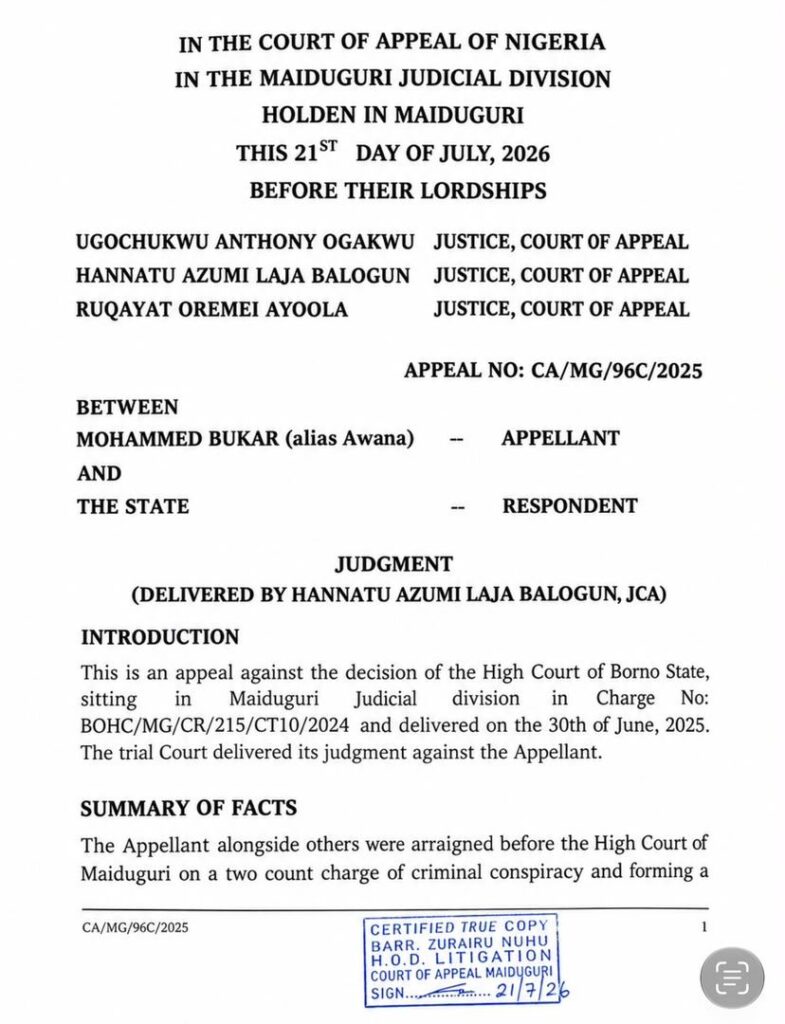
The lawyer cited the recent judgment of the Court of Appeal, Maiduguri Judicial Division in Mohammed Bukar v. The State, CA/MG/96C/2025, delivered on 21st July, 2026 by Hon. Justice Hannatu Azumi Laja Balogun, JCA, with Justices Ugochukwu Anthony Ogakwu and Ruqayat Oremei Ayoola concurring.
According to the Certified True Copy of the judgment obtained, the Appeal Court overturned the decision of the High Court of Borno State in Charge No: BOHC/MG/CR/215/CT10/2024 delivered on 30th June, 2025, where the Appellant was convicted.
Dantani explained that the Court of Appeal considered allegations that persons had called on people to take up arms, including guns, knives, bows and arrows, against the Government.
The Court held that:
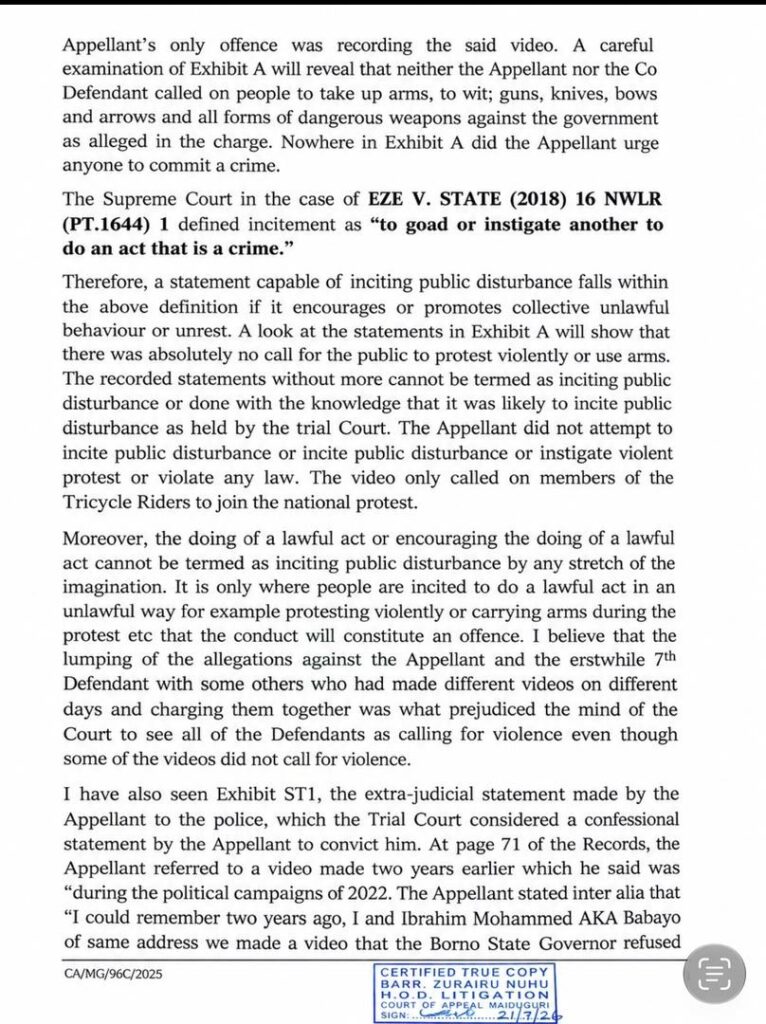
“Appellant’s only offence was recording the said video. A careful examination of Exhibit A will reveal that neither the Appellant nor the Co Defendant called on people to take up arms, to wit; guns, knives, bows and arrows and all forms of dangerous weapons against the government as alleged in the charge. Nowhere in Exhibit A did the Appellant urge anyone to commit a crime.”
The Court further relied on the Supreme Court decision in Eze v. State (2018) 16 NWLR (Pt. 1644) 1, where incitement was defined as “to goad or instigate another to do an act that is a crime.”
“Therefore, a statement capable of inciting public disturbance falls within the above definition if it encourages or promotes collective unlawful behaviour or unrest. A look at the statements in Exhibit A will show that there was absolutely no call for the public to protest violently or use arms,” the Court held.
“The Appellant did not attempt to incite public disturbance or instigate violent protest or violate any law. The video only called on members of the Tricycle Riders to join the national protest.”
The Court of Appeal stated further:
“Moreover, the doing of a lawful act or encouraging the doing of a lawful act cannot be termed as inciting public disturbance by any stretch of the imagination. It is only where people are incited to do a lawful act in an unlawful way for example protesting violently or carrying arms during the protest etc that the conduct will constitute an offence.”
Dantani said this principle is consistent with constitutional safeguards under the 1999 Constitution (as amended).
Section 36(12) provides that a person shall not be convicted of a criminal offence unless that offence is defined and its penalty prescribed in a written law.
Section 36(8) provides protection against retrospective criminal liability.
Section 36(5) preserves the presumption of innocence.
“The Police and prosecution therefore cannot create, expand or manufacture a criminal offence through an artificial interpretation of words. The alleged conduct must fall within the actual ingredients of an offence created by written law,” Dantani said.
“These constitutional safeguards are particularly important in cases involving expressions, political speech, peaceful protests, slogans or criticism of public officials. A citizen does not lose constitutional protection merely because his expression is inconvenient, embarrassing or politically unpopular.”
He therefore urged judicial officers to scrutinise such charges at the earliest opportunity.
“Conduct such as writing ‘H.E.’, calling for a political merger, shouting or interrupting a government official, or wearing a political T-shirt cannot automatically become the offence of inciting public disturbance simply because the Police or prosecution characterise it as such.”
“The constitutional principle is simple: there can be no punishment without law, no conviction without a defined offence, and no presumption of guilt merely because a citizen’s words or conduct are politically inconvenient. The rule of law requires prosecution based on law and evidence, not political interpretation, administrative convenience or subjective disagreement with a citizen’s speech or conduct.”
Documents: