Riley Moore Wins Re-Election To U.S. House, Returns To Congress As Republican Minority After Leading Propaganda On Nigeria’s Christian Genocide
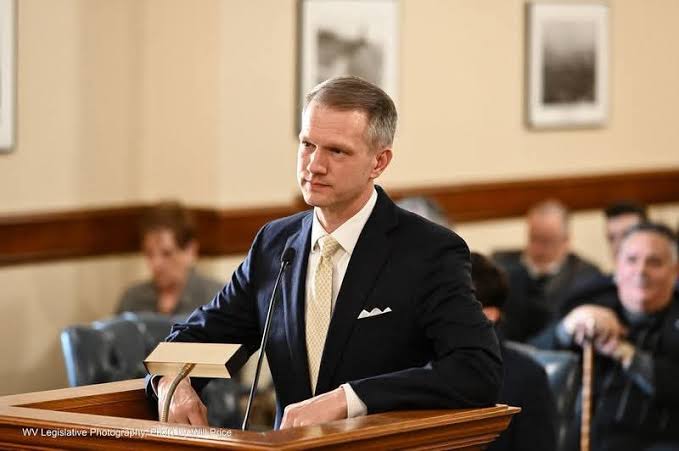
United States Congressman Riley Moore has won another two-year term in the U.S. House of Representatives, securing re-election in West Virginia’s Second Congressional District despite his Republican Party losing its majority in the midterm elections.
The Associated Press called the race for Moore at 9:22 p.m. on Tuesday night. Moore pulled in 58.6% of votes, over Democrat challenger Ace Parsi, who had 41.4% of votes, according to unofficial results with 83% of votes counted.
“It’s been an honor of my life to represent West Virginia’s Second Congressional District,” Moore wrote Tuesday night in a post on the social media platform X. “I’m proud of the work I’ve done to advance critical infrastructure investments, strengthen our aerospace and defense industries, and bring new economic opportunities and good-paying jobs to West Virginia.
“I’ll never stop fighting for West Virginians!” he wrote.
Moore is the former West Virginia state treasurer. He was first elected to the House of Representatives in 2024.
Parsi is a former Morgantown community organizer who immigrated to the United States from Iran as a child. He won the Democratic primary over Democrats Stephanie Spears Tomana, a Fairmont teacher, and Steve Wendelin, who retired from the U.S. Navy.
In a statement late Tuesday, Parsi said he had called Moore and conceded the race. He said he hopes Moore “will show up for every West Virginian in this district, because they deserve nothing less.”
“I have had literally thousands of one-on-one conversations at this point,” Parsi said. “I carry these stories with deep gratitude and they fuel a mission to serve these people with everything I have. West Virginians saw something special in me, lifted it up, and added their own talents to the pot: designs, videos, music, conversations and jokes. Together, we built a campaign I never could have dreamed of creating on my own. To every volunteer, donor, and voter who was part of it: thank you.”
Moore’s Role On Nigeria’s Christian Genocide Propaganda
Moore returns to Washington as one of the loudest voices in Congress on the alleged persecution propaganda and killing of Christians in Nigeria — a cause that has defined his second year in office and put him at the centre of U.S.-Nigeria relations.
The West Virginia lawmaker, a member of the House Appropriations Committee, led a bipartisan congressional delegation that investigated alleged persecution of Christians in Nigeria and presented a comprehensive report to the White House in February 2026, with recommendations for President Donald Trump.
In the same month, he authored the Nigeria Religious Freedom and Accountability Act of 2026, H.R. 7457, co-sponsored by House Foreign Affairs Africa Subcommittee Chairman Chris Smith. The bill directs the U.S. Secretary of State to evaluate whether Fulani ethnic militias meet the statutory criteria for designation as a Foreign Terrorist Organization, FTO, and requires an annual audit of whether U.S. security assistance inadvertently encourages religious persecution.
Moore also drove the aid-conditionality fight in the Fiscal Year 2027 National Security, Department of State and Related Programs Appropriations Act, tying U.S. assistance to Nigeria to measurable steps to protect Christians. The House first approved withholding 50% of aid, then passed an amendment by Rep. Gregory Steube to withhold 100% until Nigeria meets specific conditions to tackle the violence. The House passed the bill 217-209 on July 15.
On the House floor, Moore argued that “America CANNOT allow slaughter of Christians to continue.”
He has repeatedly accused the administration of President Bola Tinubu of “spending millions lobbying Congress while failing to adequately address” what he described as the genocide Nigerian Christians face daily.
He also publicly clashed with former Kano governor Rabiu Kwankwaso, accusing him of complicity for instituting Sharia law in Kano and signing legislation making blasphemy punishable by death.
One year after Nigeria was redesignated a Country of Particular Concern, CPC, Moore said Christians in Nigeria “continue to face unspeakable violence” and that Nigeria recorded its first Christmas without a massacre of Christians in recent memory, but insisted that “much more needs to be done.”
“Christians in Nigeria, and around the world, continue to face unspeakable violence. On this anniversary, we must rededicate our efforts to defend Christians in Nigeria and anywhere they face persecution,” Moore wrote.
Returning With The Minority
Moore’s re-election comes as Democrats have taken control of the House and Senate in the midterms, flipping the chamber and pushing Republicans into the minority.
That shift means Moore will return to Congress in January without the majority leverage he used to push the Nigeria provisions through the Appropriations Committee — but with a higher national profile on religious freedom and a record that his supporters say will make him a leading opposition voice on the issue.
For Nigeria, his return signals that pressure from Washington over Christian persecution is unlikely to fade, even as the balance of power in Congress changes.